


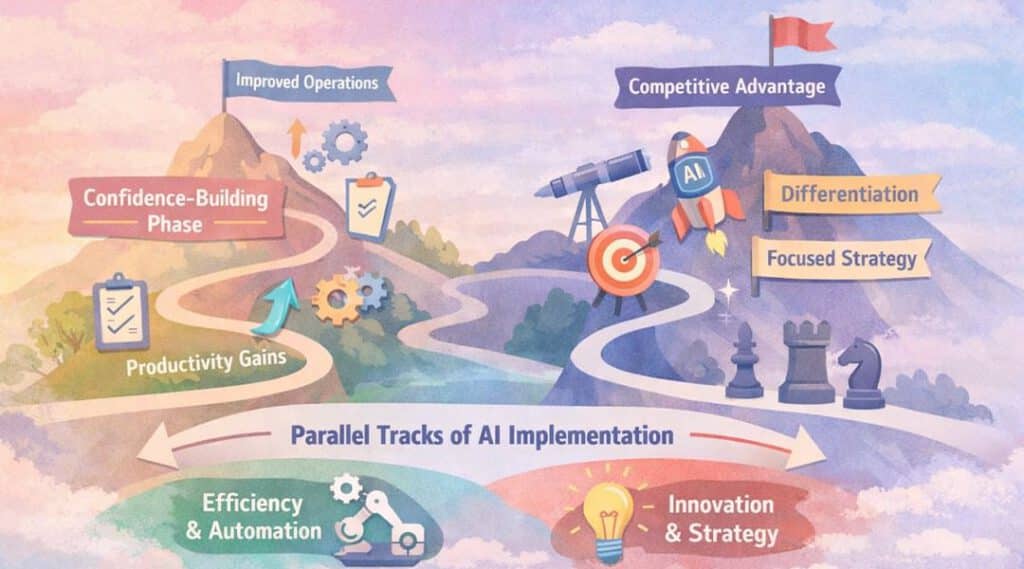
One of the many things I learned in 2025 is the importance of aligning AI strategy and prioritizing AI implementations early on with the corporate strategic focus and competitive positioning. Simply to allow investments to demonstrate maximum business impact and market performance. Once you hear it, it seems to be a no-brainer.
But – also this year – I read a lot of articles on LinkedIn and elsewhere suggesting that everybody should start using AI to improve (internal) efficiencies first (actually ignoring different strategic focuses). What appears to be a fair approach for businesses that position themselves as ‘cost leaders‘ according to Michael Porter’s generic competitive strategies (like OTC and generics manufacturers in pharma) might not be the ideal strategy for others (like science & innovation-driven enterprises). But following the general flow, I observed many companies factually driving their business through ‘differentiation‘ or ‘focus‘ (and less through ‘cost leadership’), starting their AI journey by investing in internal operational efficiencies, e.g., by initially prioritizing the rollout of AI workplace tools.
So, how to solve the dilemma?
- On one hand, it is certainly easier to start your AI with internal operational efficiencies, which are often the lower-hanging fruit. To tactically invest (to a limited extent) in related AI activities, even if this is not a strategically focused investment. This can be a smart start, paving the way for general acceptance of AI across the organization. It is tangible, lower-risk, ROI is most measurable, and employees can experience AI as a partner, making their daily work better.
- On the other hand, starting with operational efficiencies might simply be a bad excuse for not taking the effort to align AI use with strategic priorities and for following mainly a “we also want to do something with AI” ambition. Ultimately, AI would primarily enhance internal self-administration and bureaucracy rather than driving strategic outcomes for the business in the markets. Siloed tech initiatives rather than business transformation efforts.
Fortunately, I had the opportunity to discuss this challenge with some smart people (special kudos to Brian Charles). And not surprisingly, we ended up with the solution to … do both. Not one vs the other.
The way to resolve the tension for companies driven mainly by ‘differentiation’ or ‘focus’ is to treat efficiency-focused AI projects as a “confidence-building phase” while also launching a parallel track of strategic AI experimentation. So, all other AI use cases selected and prioritized support the company’s competitive positioning, whether it is ‘differentiation’ or ‘focus’. Thereby, achieving maximum mid- to long-term business impact, market performance, and future readiness. The goal is to build momentum and learning capacity while maintaining a focus on long-term value creation. In practice, AI use cases are to be categorized not only by expected ROI but also by their alignment with the strategic focus. That way, even early wins can ladder up to broader, more impactful outcomes.
The real nut to crack with AI is not a lack of ideas/opportunities. It is not technology. It is not data (at least manageable). Hesitant employees might be, but with the right approach, perhaps less than assumed. The real challenge is reaching a mature strategic understanding of AI, enabling smart prioritization aligned with strategic business priorities and outcomes. This is critical to invest resources and budget in impactful initiatives.
